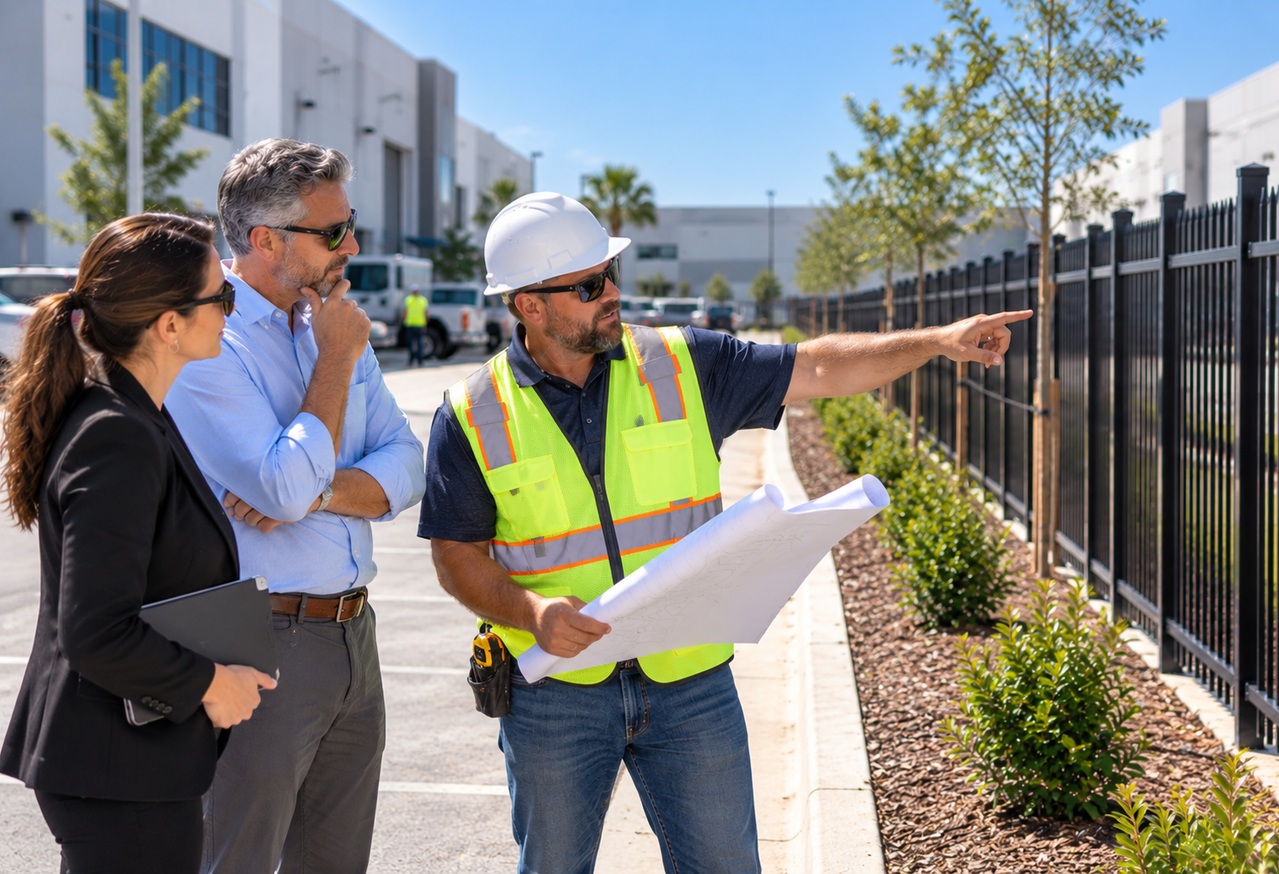
On a multi-building commercial site, good fencing contractors should give you a phased schedule that keeps your operations running, a clear plan for every gate and access point, fence and gate designs that meet Florida wind requirements, and one project manager who answers your calls from start to finish. If a contractor can't commit to all four, the project will end up managing you.
Larger sites bring more moving parts: tenants, deliveries, security, and other trades on the property. At Masters Fence, our Jacksonville crews handle commercial installs across Duval County and Northeast Florida. If you're planning a multi-building project, schedule a site visit with our team at (904) 510-6540.
How should fencing contractors phase work around your business operations?
Break the site into sections and schedule each one around how your business actually runs: shift changes, delivery windows, and customer hours. No building should lose its access while crews work.
On a distribution or light industrial campus along the I-295 or I-10 corridors, trucks may be running nearly around the clock. Office parks on the Southside have tenants arriving at 8 and customers through the day. A professional contractor maps those patterns before setting a schedule. Posts and footings go in first where they cause the least disruption, and gates and cross access points come last, once traffic has a clear alternate route.
We worked with a Jacksonville client who needed fencing around multiple buildings while a major construction project was underway on the same property. Concrete trucks, paving crews, employees, and other subcontractors all had to move through the site every day. That kind of job only works when the fence crew plans each phase around everyone else's schedule, keeps lanes open, and communicates daily about what's changing.
How are gates and controlled access points coordinated?
Gates are planned around vehicle size, traffic volume, and security level, then coordinated with your access control, electrical, and fire department requirements. They're usually the most complex part of a commercial fence.
Truck entrances often need wide cantilever slide gates, which roll without a ground track and handle Jacksonville's sandy soil well. Employee parking may need a swing or slide gate on a card reader or keypad, while pedestrian gates need latches and hardware that meet accessibility and life safety rules. Fire rescue needs a way through, typically a lock box or an override on automatic gates. When a permanent gate is still being fabricated, a temporary gate can hold a lane open, so no entrance is ever fully closed.
A good contractor coordinates with your security vendor and electrician early, so conduit is run before paving, and gate operators are sized for the gate's weight and wind load. Our fence installation proposals show every gate, its type and width, and who is responsible for power and access hardware.
Why does wind-rated engineering matter for Jacksonville fences?
Because tall fences and large gates act like sails in a storm. Florida Building Code wind requirements apply, and larger or taller installations may need engineered post sizing, spacing, and footings.
Jacksonville sees tropical storms, nor'easters, and the occasional direct hurricane threat, as the region was reminded during Hurricane Irma in 2017. A privacy screen on a chain link fence, solid vinyl, or large sliding gates all increase wind load. That means heavier posts, closer spacing, deeper concrete footings, and sometimes engineered drawings for the permit. Coastal sites closer to the beaches or the St. Johns River may also call for coated or aluminum materials that resist salt air.
Ask any contractor how they account for wind in their design. A vague answer is a warning sign on a commercial project. Wind design also pays off after a storm. A fence built to the right spec is far more likely to still be standing, which keeps the site secure at the moment you need it most.
Why do you need one project manager as your single point of contact?
Because on a multi-building project, questions come up every day. One person who knows the plan, the schedule, and the site keeps decisions fast and prevents miscommunication.
Your project manager should confirm utility locates and permits before work starts, share a schedule you can post for tenants and staff, report progress regularly, and flag problems early, like an unmarked line or a conflict with another trade. You shouldn't have to chase three different crew leads to get an answer. At the end, you should get a walkthrough, a punch list, and warranty details in writing. After installation, the same team can handle fence repair if a gate gets hit by a truck or a section is damaged in a storm, which is common on busy sites.
If you're planning a commercial project, call (904) 510-6540 or book a site visit with our fencing contractors. We'll walk every building with you and build a plan around how your site works.