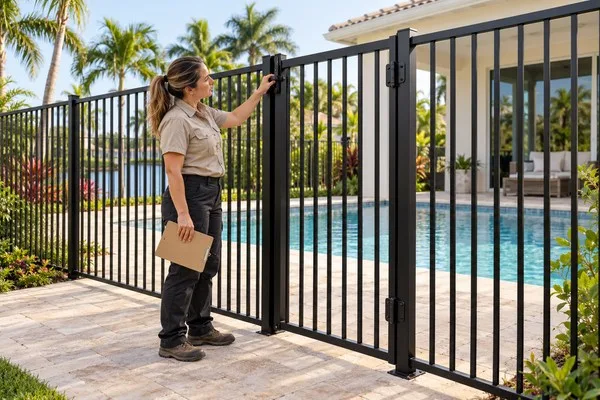
A new backyard fence around a pool in Palm Coast has two jobs. It has to look right, and it has to work as the safety barrier a city inspector checks before your pool gets final approval.
Good fencing contractors build to that inspection from the first measurement. Height, gaps, gate hardware, paperwork. Miss one and you are paying for a reinspection, or for tearing out a run that was set wrong.
At Masters Fence, we build pool fences across Palm Coast, St. Augustine, and Jacksonville with the code in mind from day one. If you want yours done right the first time, reach out to our team at (904) 510-6540 for a fast estimate.
What do fencing contractors in Palm Coast check on a pool barrier?
They check height, gaps, what is happening under the fence, and anything nearby a child could climb. Every one of those comes straight from Florida's pool barrier rules, and every one gets measured at inspection.
Under Section 515.29 of the Florida Statutes, the barrier must stand at least 4 feet tall on the outside, with no gaps or footholds a young child could squeeze through or climb. Inspectors test it with a 4-inch sphere. If it passes through anywhere, the fence fails.
Picket spacing gets stricter on some styles. When the horizontal rails on an aluminum or vinyl panel sit less than 45 inches apart, a kid can use them like a ladder, so the Florida Building Code tightens the gap between pickets to 1-3/4 inches.
Then there is the bottom edge. Code allows no more than 2 inches between the ground and the fence on the outside. Lots along the Palm Harbor canals make this tricky, because the yard often slopes toward the seawall, and a fence set level at one end can leave a 4-inch gap at the other.
We also look at the AC unit, the pool pump, and any planter near the fence line. If a child can step on it and get over, either it moves or the fence does.
How does a contractor document the fence for a Palm Coast pool inspection?
A code-aware contractor gets the fence on paper before the pool permit is approved, because Palm Coast wants to see the barrier in the plans first. The final inspection is the second check, not the first.
When a fence will serve as the pool barrier, the City of Palm Coast Building Division has required a fence permit or acknowledgement before it approves the pool permit. Reviewers at City Hall on Lake Avenue have also sent site plans back for not showing the existing fence's height and material.
So we put it in writing. Fence height measured on the outside, picket spacing, every gate location, which way each gate swings, and the latch we are installing. The plan reviewer and the field inspector end up looking at the same fence your pool builder planned around.
That matters when a pool company and a fence company work the same yard at different times. The pool contractor usually calls in the final. If the fence never made it onto the plan, that final stalls while everyone figures out whose problem it is.
Why do so many pool fences fail inspection at the gate?
Because the gate is the only part of the barrier that moves, and it carries the strictest rules. A fence can be perfect down every run and still fail because one gate swings the wrong way or will not latch on its own.
Florida requires pool gates to open outward, away from the pool, and to be self-closing and self-latching. Palm Coast inspectors have turned down pool finals for exactly that: a side gate that swung in toward the water instead of out.
The latch has its own rules. The latching device sits on the pool side, with the release at least 54 inches above the bottom of the gate. Set it lower and code moves the release to the pool side near the top, with no opening over 1/2 inch within 18 inches of it.
Hardware is where cheap installs fall apart. Homes near the Intracoastal Waterway get plenty of salt in the air, and a bargain hinge spring can rust and lose tension. The gate stops pulling itself shut, and a barrier that passed inspection no longer does its job.
"Do we need to talk about the gate so much?" one of our customers asked us. He had been focused on the fence panels. But his grandchildren were going to get a lot of use out of that pool, and he was glad we went through the gate in detail.
Is a cheap fence install worth the risk on a pool barrier?
Usually not. A low bid that ignores pool code tends to cost more by the time it passes, because a failed final can mean a reinspection fee, a return trip, and sometimes posts pulled and reset.
Watch for the installer who quotes a pool fence the same way they quote a fence for the dog. Ask how they handle the 2-inch rule on a sloped yard, which latch they plan to use, and whether the fence will be on the site plan. Slow answers tell you plenty.
As a residential fence contractor working Palm Coast, St. Augustine, and Jacksonville, we treat the pool barrier as its own job inside the fence job. We check the grade before setting posts, pick gate hardware that holds up near the coast, and place gates around how your family actually walks to the pool.
If your pool fence has to pass the first time, request a quote from our team today or call (904) 510-6540. We will walk the yard, mark where the barrier and gates need to go, and get you a clear estimate fast.