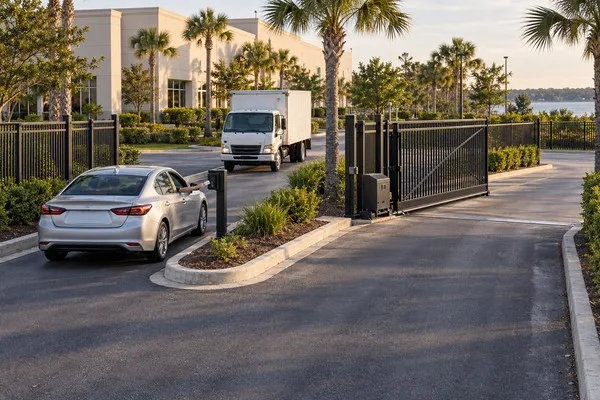
One entrance, three kinds of traffic. Employees arriving for a shift, customers pulling in, and a delivery truck trying to back through the same opening at the same time.
When that is your site, commercial fencing is really a traffic plan with a fence attached. The gate type, the opening width, and the access controls all have to be decided before anyone can give you a quote that holds up.
Masters Fence plans and installs access-controlled gates for businesses across St. Augustine, Jacksonville, and Palm Coast. If you are fencing a busy site, reach out to our team at (904) 510-6540 and we will help you spec it right the first time.
Should a St. Augustine business use a swing gate or a sliding gate?
For most shared commercial entrances, a sliding gate is the safer pick. Swing gates cost less and work well, but only when there is open, fairly level ground for the gate to sweep through without hitting a parked car or a person.
A swing gate needs its full arc kept clear every time it opens. On a tight lot, that means losing parking spaces or painting a no-stopping zone that drivers will ignore. A slope at the entrance can also leave a leaf dragging on the high side.
A cantilever slide gate rolls along the fence line instead. The tradeoff is room: it needs a straight run of fence beside the opening to roll back into, often around half the width of the gate. If a building, a dumpster pad, or a property line sits there, the slider is off the table.
Location adds another layer. A commercial property inside one of St. Augustine's historic districts may need review by the city's Historic Architectural Review Board on top of the building permit, which can shape the gate's style and height. We flag that before quoting, not after.
How wide should a commercial gate be for delivery trucks?
Wider than the truck. The real question is the turn, because a box truck coming off a busy road needs room to swing in without stopping in traffic or clipping a post.
Federal rules cap most trucks at 102 inches wide, but that number barely matters at the gate. What matters is the angle. A straight shot off a side street needs far less opening than a hard right turn off a four-lane corridor like State Road 16 or US 1, where drivers want to get out of the travel lane fast.
We walk the entrance and watch how trucks actually approach it. Then we look at height. Overhead arms, signs, or a rolling gate's top track can all catch a tall truck. Getting this wrong is the most expensive rework there is, because widening an opening means moving posts, footings, and often the operator.
Which keypad or card reader works best for a shared entrance?
The right reader depends on who comes through and how often. Employees usually do best with cards or fobs, while delivery drivers need a code, an intercom, or a call box that someone inside can answer.
Cards and fobs let you shut off one person's access when they leave without changing a code for everyone. Keypads are simple and cheap, but shared codes travel. Many systems let you set time windows, so a vendor code only works during receiving hours.
Mount the reader where a driver can reach it from the cab window without getting out, and add a vehicle detector on the exit side so trucks leave without a code.
Near the coast, on Anastasia Island or along A1A, salt air is hard on electronics, so we spec sealed housings and stainless hardware. If you already have a gate that sticks or a run that is leaning, our fence repair crew can fix it before the access system goes in.
How do you keep pedestrians and trucks apart with commercial fencing?
Give people on foot their own gate. The UL 325 safety standard for automatic gate operators calls for a separate pedestrian opening wherever there is foot traffic, so no one has to walk through the path of a moving vehicle gate.
That pedestrian gate can share the same reader or have its own, and it should sit where employees naturally walk from the parking area. Put it in the wrong spot and people will cut through the vehicle gate anyway, which defeats the whole design.
A bakery owner we worked with told us his deliveries always seemed to arrive at the same time as his employees. Seeing that play out in real time helped us put together a plan for gate placement that made the mornings smoother for everyone.
That is the kind of thing a drawing on a desk will not show you. Before you get bids, schedule a commercial site assessment with Masters Fence or call (904) 510-6540. We will watch your entrance, map who uses it, and price the gates around how your site actually runs.